
encountering the hidden other
I wanted to be a marine biologist. Not because I was drawn to science exactly — but because I wanted to understand how it all moves together. The depth and the surface and the vast space between and beyond. The hidden life. The patterns of connection. The living system beneath the living system.
It turns out that's what I've always done. Just not in the ocean.
All my life, something moved through me that I didn't understand. I only knew it by its effects. People told me everything. Strangers. Students. Friends. People I had just met. I would say hello and something would open in them and the stories would start coming. I didn't know why. I only knew the hunger it seemed to create — sometimes beautiful, sometimes alarming — and that I didn't always know how to stay still inside it without being pulled under.
I was taught to hide it. To doubt it. To shame it into something small enough that others didn't have to feel intimidated or exposed by it. To protect their illusions of safety and my own, I abandoned core parts of myself as the price of belonging. I became almost flawless in appearing smaller than I was with almost no visible sign of what it cost.
What I didn't understand then was that I was fighting myself and that the fighting masked the grief beneath my pain.
Eventually, life forced me to stop. Not gracefully. Just completely.
What followed was a long process of walking myself home. I took the old maps and reworked them. Re-membering — putting back together what had been separated — piece by piece, without knowing what I was building toward. Learning along the way that getting lost is the medicine, because it initiates you into a relationship with uncertainty deep enough to shed the remnants of your becoming into the fire of your wyrd.
Wyrd. Old English. To become. To turn toward what you already are.
Becoming names the motion. Wyrd names the pattern within the motion — the particular shape that belongs to this life and no other. If becoming is the river, wyrd is the specific course this river cuts. Not predetermined. Not random. It runs true to something.
This is the ecology I tend now. Not the ocean or the forest, though I grieve them both and that grief is part of this work too. The remnants. The things that are being swallowed. The hidden life that persists underneath the surface of what fear has made of the world — in people, in ecosystems, in the stories that never got to be told.
I can't stop what is being lost. But I can sit with you in the remnants of yourself — the parts that were swallowed, suppressed, promised and taken, named and then unnamed — and witness what is still alive there. What persisted. What is trying to surface.
I love this work, and I don't always want to do it. It feels less like a profession and more like a surrender to something that moves through me whether I am ready or not. For most of my life that something moved through me without my consent. I gave it away because I didn't understand that the energy required to wield it with integrity was something I needed to protect.
The difference now is that I get to choose when I open the door, and this work is my devotion to the calling I was taught to shame and have reclaimed with love.
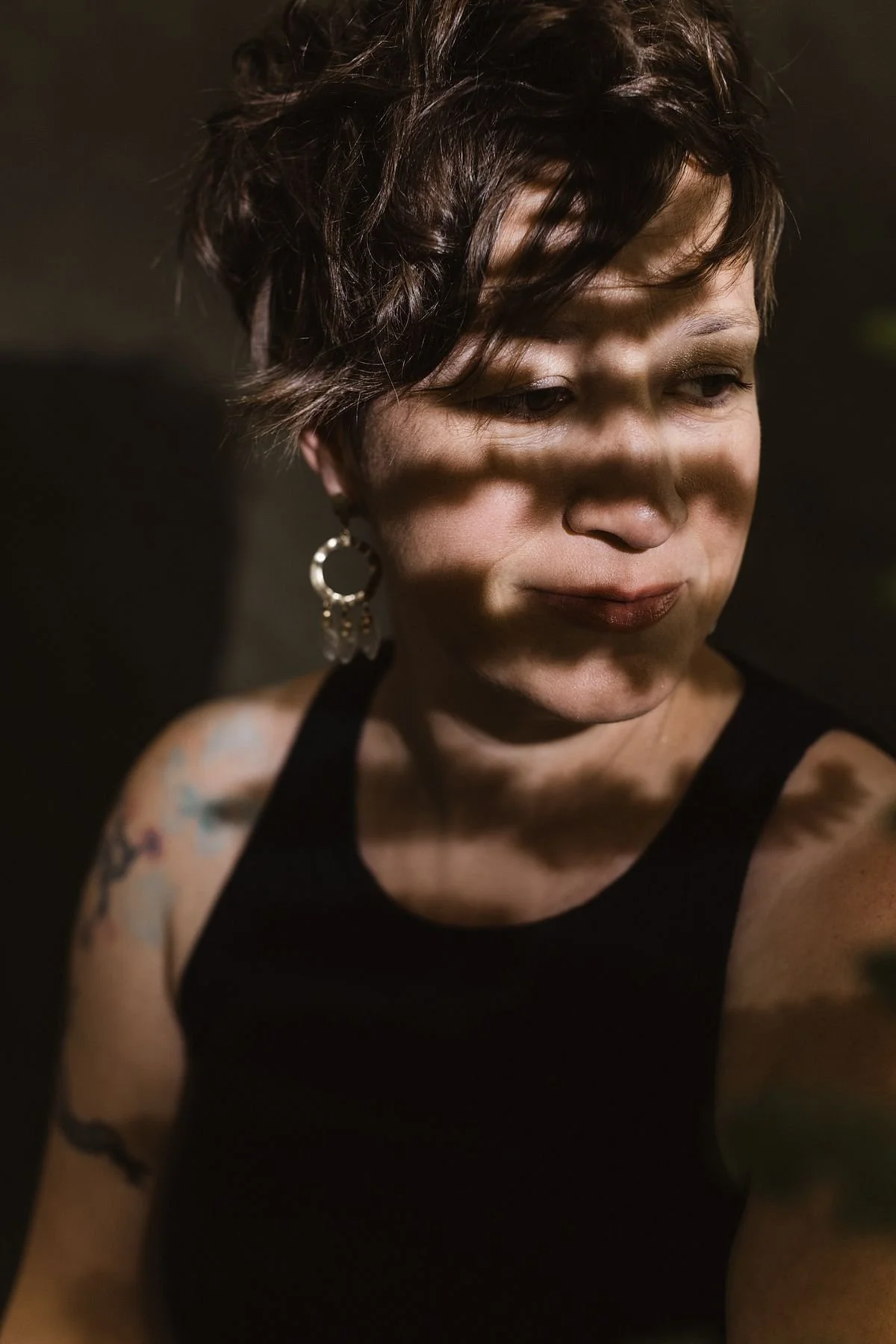
Jaymi Jai is a presence-based practitioner working with individuals in Canada, the US, and internationally via Zoom. She brings fourteen years of classroom experience — including work with at-risk and neurodivergent youth — into a private practice she has held since 2021. She holds a BEd and a trauma-informed coaching certification, and continues her training in somatic and relational modalities. Based on Vancouver Island, BC.